
Free whitepaper (German only):
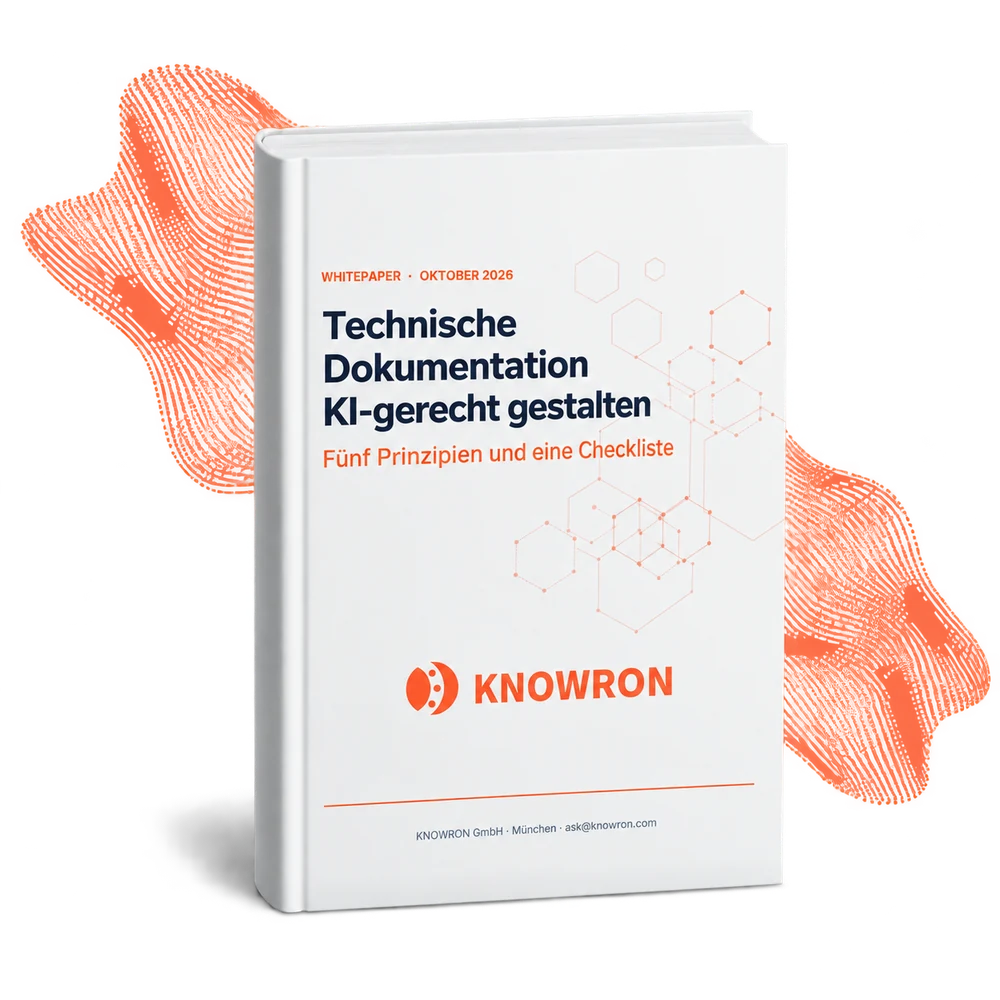
AI assistants increasingly answer technicians’ questions directly from manuals and service documents. How good those answers are depends on the documentation. Our whitepaper uses five principles and concrete before-and-after examples to show how to structure technical documentation so that people and AI systems can use it equally well. Please note: the whitepaper is available in German only.
Download whitepaper (PDF, German only)
From 20 January 2027, the EU Machinery Regulation 2023/1230 allows manufacturers to provide operating instructions in digital form. For many technical writing teams, that is a reason to revise their templates.
At the same time, who reads those manuals is changing. According to a Bitkom survey from September 2026, 57% of companies in Germany with 20 or more employees already use artificial intelligence. In service and maintenance, this means technicians ask an AI assistant instead of leafing through a PDF. Whether the answer is right depends less on the AI model than on the source. If you are revising your templates for the digital manual anyway, make them AI-ready in the same step.
A technician reads a page in context and sees from layout, colours and position what belongs together. An AI assistant, by contrast, selects individual sections and only processes what exists as text. Legends inside graphics, tables built from loose text boxes or a scope that is only stated on page 2 get lost along the way. The good news: you don’t have to replace the PDF. What matters is how it is built.
Anything a technician needs to read from an image also belongs in the document as text. If you can’t select it in the PDF, it doesn’t exist for the AI.
One value per cell, one row per cause and remedy, conditions next to the value rather than in a footnote.
Which machine a section applies to and where a cross-reference leads belong in the section itself.
Maintain error, spare-parts and variant lists as tables and generate the PDF from them.
A synonym list connects the terms in the manual with the words technicians actually use.
Two questions are enough for a first check: Can you select the text with your mouse? Is the section understandable without the rest of the chapter? If the answer to either is “no”, an AI system can’t use the information reliably either.
For heads of technical documentation, technical writers, and service and product teams at machine and plant manufacturers and operators who use or plan to use AI assistants, full-text search or service portals. The whitepaper is written in German.
No. The PDF remains the approved format. The principles start with templates and structure.
No, they apply to every AI system, every full-text search and every service portal.
With the template: changes there take effect in every new document. The checklist in the whitepaper shows the order.
For more background and examples, read the blog article by our founder and CPO Arturo: How to optimize your technical documentation for AI.
Want to know where your own documentation stands? Send us a sample document at ask@knowron.com and we will check it for free against the criteria in the whitepaper.
Download the whitepaper (German)Our experts are on hand to run you through how KNOWRON:
No commitment, no obligation—just a demo to show you how AI-powered knowledge management can change the game for your business.

Copyright 2026 © KNOWRON | Made with 🥨 in Munich

